

October is Breast Cancer Awareness Month, and every year it gives me a reason to talk with patients about prevention and screening.
But I also think these conversations are an opportunity to talk about women’s health more broadly. A visit for a mammogram or other recommended breast cancer screening shouldn’t only be about checking a box. It’s also an opportunity to talk with your doctors about how you’re actually feeling.
Hormonal changes across a woman’s lifespan can influence so much of how we feel and function. And that brings me to an important conversation I have with women almost every week in my practice: perimenopause and menopause.
If you live long enough as a woman, you will go through this transition.
So many of my patients arrive in my office describing the same quiet bewilderment. Sleep that no longer feels restorative. Periods that have become unpredictable. A shorter fuse than usual. A body that feels different, even though nothing about their routine has changed. Changes in weight or body composition that don’t seem to make sense.
They often ask me some version of the same question.
“What is happening to me?”
These changes can feel unsettling, but many have a physiological explanation, and understanding what’s driving them is the first step toward deciding what deserves evaluation and what will actually help.
Menopause isn’t just “getting older.”
It’s a biological transition driven by changing ovarian hormone production. Because those hormones interact with so many systems in the body, the effects can show up in your sleep, temperature regulation, mood, bone density, metabolism, and more.
It’s not one symptom. It’s often several systems adjusting at once, which is part of why it can feel so disorienting.
Menopause Is a Transition, Not a Single Day
We tend to talk about menopause as though it’s an event, a switch that flips. In practice, it’s a gradual unfolding, and it looks different for every woman I see.
Perimenopause is the lead-up. Hormone levels start to fluctuate, sometimes for years, and cycles can shift. Shorter, longer, heavier, lighter, or just less predictable than they used to be.
Some women notice hot flashes, sleep changes, or mood shifts well before their periods actually stop.
Menopause itself is a retrospective diagnosis. We only confirm it after twelve consecutive months without a period, with no other explanation for the absence.
In the U.S., the average age is around 51, though I’ve cared for patients on both sides of that number. There’s no single timeline that every woman is supposed to follow.
Early menopause, before age 45, happens to some women. When ovarian function declines before age 40, we may instead be dealing with premature ovarian insufficiency (POI), which isn’t quite the same thing as menopause and deserves its own evaluation.
When this happens earlier than expected, we pay close attention. A longer stretch of life with lower estrogen exposure has real implications for long-term health, so this is a case where individualized care matters even more than usual.
Postmenopause is everything after. Periods have ended, but your health story hasn’t.
The effects of declining estrogen on bone and cardiovascular health matter well beyond the last period, which is why the conversation about the menopausal transition doesn’t end when the hot flashes calm down.
Why it Feels Like Everything is Shifting at Once
Estrogen and progesterone get filed under “reproductive hormones,” but their reach is much wider than that.
Estrogen and progesterone influence tissues and systems throughout the body—including the brain, bones, cardiovascular system, and reproductive tract. That’s part of why the transition can touch sleep, mood, temperature regulation, cognition, bone health, metabolism, and body composition all around the same time.
I think of it less as a list of unrelated symptoms and more as several interconnected systems responding to the same underlying hormonal transition. Changes in ovarian hormones can affect everything from temperature regulation and sleep to mood and cognition, which is why one change can sometimes seem to spill into another.
When sleep becomes fragmented, it doesn’t just leave you tired. Poor sleep can affect attention, mood, emotional regulation, and how well we cope with stress the next day, which can amplify irritability or brain fog and make it harder to unwind again that night.
It’s a loop, not a coincidence. Naming that loop is often the first relief a patient feels.
Some of what shows up during this time: hot flashes or night sweats, disrupted sleep, brain fog, mood changes or increased anxiety, fatigue, joint or muscle soreness, changes in sexual or vaginal health, shifts in body composition, and changes in your cycle itself.
Not everyone experiences all of these, and they don’t arrive in any fixed order.
If your experience doesn’t match your mother’s or your sister’s or a friend’s, that’s not a sign something is off with you. There isn’t a single template for this transition.
And although these symptoms can be common, that doesn’t mean you simply have to suffer through them.
There Is No Single Menopause Experience
Hot flashes and night sweats—also called vasomotor symptoms—are among the most recognizable symptoms of menopause.
But even here, the range is wide.
I’ve seen patients with occasional, mild warmth and others who wake several times a night drenched. Some notice them starting in perimenopause. For others, they arrive later.
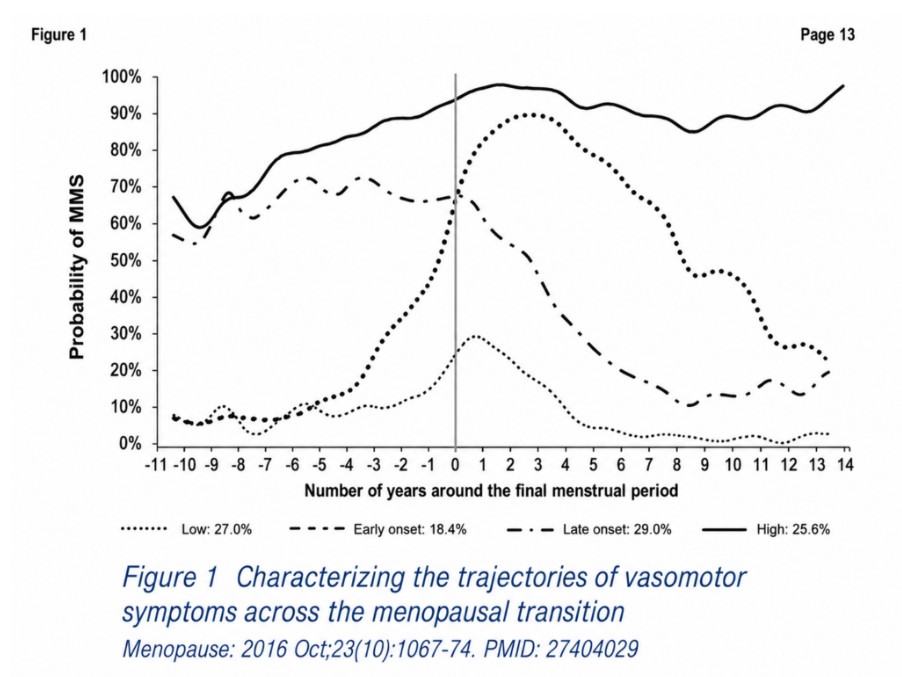
The research bears this out. As the graph below shows, the timing, frequency, severity, and duration of vasomotor symptoms can vary considerably from person to person. There’s no single menopause experience you’re supposed to match.
Understanding Your Own Pattern Is More Useful Than a Symptom Checklist
What I’d ask you to take from this isn’t a checklist to compare yourself against.
It’s an invitation to get curious about your own body.
What’s changed, and when did you first notice it? How is it impacting your sleep, your energy, your patience, your relationships, or your ability to show up the way you want to in your own life?
Those specifics are what actually guide good care, far more than where you land on a symptom list.
Understanding what’s happening physiologically can be the first real step toward figuring out what you need to feel more like yourself.
Is sleep one of the things that has changed for you? If so, you might want to check out this article I wrote explaining how sleep changes during this transition: “Menopause and Sleep: Why Sleep Changes During Perimenopause and What Can Help” next.
And if you’re navigating changes that you aren’t quite sure how to make sense of, schedule a free Meet & Greet with me. We can talk about what you’ve been experiencing and what the next best step may be.